Why Your Apartment Is Wrecking Your Focus (And It Has Nothing to Do With Your Phone)
You've tried the productivity hacks. You've deleted TikTok twice. You've bought the fancy planner with the motivational quotes on every page. And yet, the moment you sit down to actually do something in your apartment, your brain just... evaporates.
Here's a thought: what if it's not you? What if the problem is the four walls around you?
The way your apartment is laid out—where the couch sits, how the kitchen bleeds into your workspace, which direction your desk faces—has a measurable psychological effect on your ability to concentrate. Spatial designers and environmental psychologists have been onto this for years. The rest of us are just now catching up.
Let's talk about what's actually going on, how to spot it in your own place, and what you can realistically do about it—even if you're renting and can't touch a single wall.
The Psychology Behind Apartment Flow
Every apartment has what designers call a flow—the natural path your eyes and body travel through the space. When that flow is interrupted, cluttered, or contradictory, your nervous system registers it as low-grade stress. You don't notice it consciously, but your brain is constantly processing it in the background, like a tab you forgot to close.
Think about the last time you walked into a hotel lobby or a well-designed coffee shop. There's a reason those spaces make you feel instantly oriented and calm. The sightlines are clear, the zones are obvious, and nothing is competing for your attention. Your apartment can work the same way—but most don't, especially rentals designed to maximize square footage rather than livability.
The result? You sit down to work and within ten minutes you're folding laundry, staring into the fridge, or reorganizing a shelf you reorganized last Tuesday. It's not laziness. It's your environment giving you zero psychological permission to focus.
Run This Diagnostic on Your Space
Before you start rearranging furniture at 11pm (we've all been there), take ten minutes to actually assess what you're working with. Walk through your apartment like a stranger seeing it for the first time and ask yourself:
1. Can you see your bed from where you work? This is a big one. If your desk has a direct sightline to your unmade bed, your brain is receiving a constant "rest" signal. It's like trying to focus in a bedroom—because you literally are.
2. Does your living room serve too many masters? If the same couch is where you Netflix, eat dinner, take Zoom calls, and decompress after work, your brain has no idea what that space is for. Mixed-use zones without visual separation are productivity killers.
3. Where does the natural light hit during your peak work hours? Light that's behind you creates glare on your screen. Light that's in front of you can cause eye strain. Light that hits your face from the side? That's the sweet spot. If your current setup doesn't take advantage of it, you're fighting your own environment all day.
4. What's the first thing you see when you walk in the door? Your entry sets the psychological tone for everything that follows. If the first thing you see is a pile of shoes, unopened mail, and a dying plant, your brain clocks that as chaos—and carries it into the rest of your day.
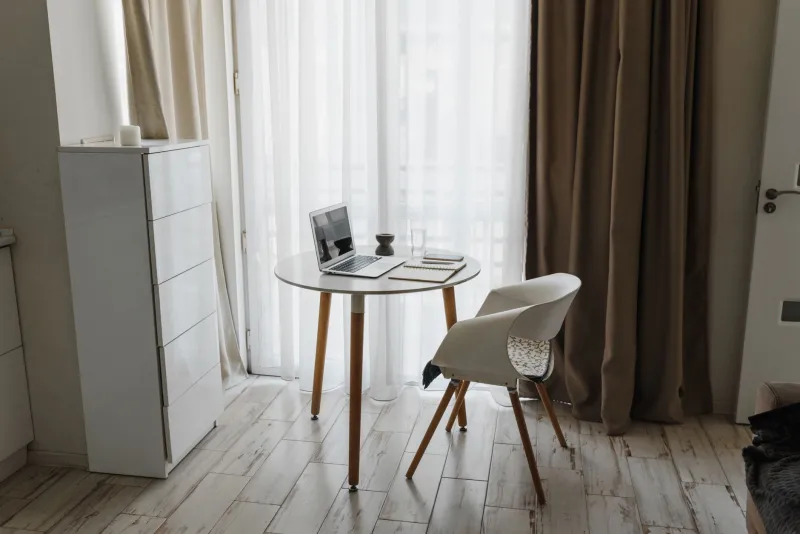
5. Is there a defined "work zone" at all? For renters in studios or one-bedrooms, this is the hardest question. If the answer is "kind of, I guess the kitchen table counts," that's worth addressing.
Renter-Friendly Fixes That Actually Work
Here's the good news: you don't need a bigger apartment, a renovation budget, or your landlord's blessing to fix most of these issues. What you need is intention.
Create Zones With Furniture, Not Walls
A bookshelf placed perpendicular to a wall can divide a studio into two distinct areas without blocking light or requiring any drilling. A loveseat with its back to your workspace creates a visual boundary that tells your brain: this side is for work, that side is for living. Area rugs are equally powerful—two rugs anchoring two different furniture clusters can make a single room feel like two separate spaces.
Block the Bed
If you work from home and your desk faces your bed, fix this first. Even a curtain panel hung from a tension rod, a tall plant, or a folding screen can break that sightline. You don't need to physically separate the spaces—you just need to interrupt the visual connection.
Claim a Corner for Deep Work
Positioning your desk in a corner—facing the wall, not the room—actually helps concentration. It reduces peripheral visual stimulation and creates a subtle sense of enclosure that many people find grounding. Add a small task lamp, keep the surface clear, and treat it like a cockpit: everything you need, nothing you don't.
Rethink Your Entry
A $30 wall hook, a small tray for keys and mail, and five minutes of daily maintenance can completely change the energy of your entryway. When you walk in and things are in their place, you're not starting your evening on a note of low-grade disorder. It sounds small. It isn't.
Use Lighting to Signal Mode Shifts
This one is underrated. Overhead lighting tells your brain it's time to be alert and productive. Warm, low lamps signal rest and winding down. If you work and relax in the same room, use lighting deliberately—bright and cool during work hours, warm and dim in the evening. Your circadian rhythm will thank you, and so will your focus.
The Bigger Picture
Here's what most productivity content misses: you can have the best time-blocking system in the world, but if your environment is constantly undermining you, you're swimming upstream. The apartment you live in isn't a neutral container for your life—it's an active participant in it.
The good news is that most layout problems are solvable without spending a lot of money or making permanent changes. It's mostly about being intentional: understanding what each area of your home is supposed to do, and then arranging it to actually do that thing.
Your space should be working for you. If it's not, now you know where to start.