Reflect on This: The Surprisingly Simple Mirror Trick That Makes Any Apartment Feel Bigger and Better
There's a reason every designer's go-to advice for small apartments involves mirrors. They're not just decorative — they're functional magic. A well-placed mirror can pull natural light from one side of a room and throw it across a dark corner. It can make a cramped hallway feel like it actually has somewhere to go. It can turn a flat, forgettable wall into something that feels considered and alive.
But here's the thing: most renters either skip mirrors entirely or hang them in the most obvious spot without thinking about what they're actually doing. The result? A mirror that reflects the back of the couch, or worse, stares straight at you every time you sit down to eat.
Let's fix that.
Why Mirrors Actually Work (It's Not Just a Myth)
The psychology behind mirrors in interior design is pretty straightforward. Our brains perceive depth and openness based on visual cues — and a mirror essentially creates a fake wall that the eye reads as continuation of space. When you place a large mirror across from a window, you're not just bouncing light around. You're tricking your brain into thinking the room extends further than it does.
There's also an emotional component. Brighter rooms feel more energizing. Spaces with visual depth feel less claustrophobic. If your apartment has been making you feel a little boxed in, the problem might not be the square footage — it might be the absence of one well-placed mirror.
The #1 Mistake Renters Make With Mirrors
Hanging a mirror without thinking about what it reflects. Sounds obvious, but it's incredibly common. Before you put a single nail in the wall, stand where the mirror will hang and look at the angle. What will someone see when they glance at it? If the answer is "the ceiling," "the back of the TV," or "themselves from an unflattering angle every time they walk by," it's the wrong spot.
The best mirrors reflect something worth seeing — a window, a piece of art, an open doorway, or a styled vignette on a console table. Think of it like framing a second image inside your room.
Room-by-Room Mirror Strategy
Living Room
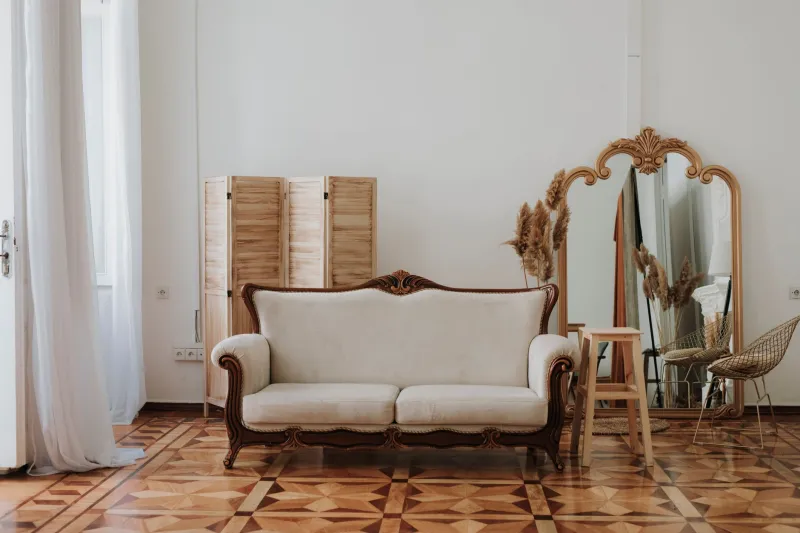
The living room is where mirrors do their most dramatic work. If you've got a wall across from your windows, that's your prime real estate. A large, statement mirror — think at least 24x36 inches — hung at eye level will catch the incoming light and distribute it across the room. The effect is especially noticeable in north-facing apartments that don't get a ton of direct sun.
Frame style matters here too. A sleek, thin metal frame keeps things modern and airy. A chunky wooden frame adds warmth but can visually weigh down a small space. If your living room already has a lot going on, lean toward simpler frames that let the reflection do the talking.
One thing to avoid: hanging a mirror directly above the sofa at a sharp downward angle. It creates a weird perspective and can actually make the ceiling feel lower.
Bedroom
Bedrooms are where mirror placement gets a little more personal — and where people make the most mistakes. A mirror directly facing the bed is a hard no for most people, not just for the obvious "waking up to yourself" factor, but because it can actually disrupt sleep. If you're sensitive to light or movement, even the subtle reflection of a passing car's headlights can be enough to pull you out of a deep sleep.
Instead, try placing a full-length mirror on the back of your closet door or on a side wall near the entrance. This gives you the practical benefit of a getting-ready mirror without the bedroom feeling watched. If you're working with a small bedroom, a leaning mirror in a corner can add depth without overwhelming the space.
Entryway and Hallways
Narrow hallways are basically begging for mirrors. A long, vertical mirror on one wall of a tight corridor creates an immediate sense of width that's almost hard to believe until you see it in person. It also serves a practical purpose — checking yourself before you head out the door.
For entryways, a mirror above a console table is a classic combo for good reason. It's functional, it creates a focal point, and it makes even the tiniest entry feel like it has a moment. Add a small plant or a candle to the console and suddenly your apartment has an arrival experience.
Kitchen and Dining Areas
This one surprises people. Mirrors in kitchens and dining rooms are less common in the US, but they're incredibly effective. A mirror on the dining room wall opposite a pendant light will double the glow of that fixture and make the whole eating area feel warmer and more intimate — especially at night.
In kitchens, a mirrored backsplash (or even just a section of one) can open up a galley layout significantly. Renters who can't do permanent backsplash changes can look for removable mirrored tile panels, which are widely available and surprisingly convincing.
Grouping Mirrors: When More Is More
Single mirrors are great, but a gallery-style grouping of smaller mirrors can be even more dynamic. The key is to treat them like a cohesive art installation rather than a random collection. Stick to a consistent finish — all brass, all black, all natural wood — and vary the shapes. A mix of round, arched, and rectangular mirrors in the same tone feels curated rather than chaotic.
This approach works especially well in living rooms and dining areas where you want visual interest without committing to a single large piece.
What to Do When You Don't Have Great Natural Light
If your apartment faces north, sits in a basement unit, or just gets blocked by neighboring buildings, mirrors become even more critical — but they need a little help. Pair your mirror placement with warm artificial lighting sources positioned nearby. A floor lamp or a wall sconce angled toward a large mirror will amplify the light output significantly. The mirror isn't creating light, but it's multiplying whatever light exists.
This is also where mirror finish matters. Highly polished, clear mirrors reflect more light than antique or smoked glass versions. If your goal is brightness, go clear. If you're going for mood and atmosphere, a slightly warmer or tinted mirror adds character without sacrificing too much reflectivity.
Quick Wins You Can Do This Weekend
- Lean a large mirror against the wall instead of hanging it — it's renter-safe, adjustable, and honestly looks really intentional right now.
- Move any existing mirror to a wall that faces a window and notice the difference in light within a day.
- Swap out a heavy, ornate frame for something simpler if your space already has a lot of visual texture.
- Add a small round mirror to a dark corner with a nearby lamp — it'll feel like you added a light source.
Mirrors are one of those rare design tools that are accessible at every budget, don't require a landlord's permission to use, and deliver results you can see immediately. Whether you're working with a studio apartment in a high-rise or a two-bedroom in a walk-up, a little strategic reflection goes a long way.