It's Not the Square Footage — It's the Flow: How to Fix a Cramped-Feeling Apartment Without Moving a Wall
You've measured the rooms. You've done the math. By every objective standard, your apartment should feel comfortable — maybe even roomy. And yet, every time you walk through the front door, there's this low-key sense of compression, like the walls are just a little too close together. You can't quite explain it, but you feel it constantly.
Here's the thing: that feeling almost never comes from the actual square footage. It comes from something invisible — the way people (and energy) move through a space. Interior designers call it circulation, and when it's off, even a genuinely spacious apartment can feel like a maze you're constantly trying to escape.
The good news? You don't need a contractor, a landlord's permission, or a massive budget to fix it. You mostly just need to know what to look for.
What "Traffic Flow" Actually Means (And Why It Matters)
Traffic flow is basically the natural path your body takes as it moves from one point in your apartment to another — from the front door to the couch, from the couch to the kitchen, from the bedroom to the bathroom at 2 a.m. These invisible highways exist whether you've thought about them or not.
The problem happens when furniture, rugs, or random objects block those paths. When you have to navigate around the corner of a coffee table, squeeze past a chair that's slightly too close to the wall, or do a little sidestep every time you walk to the kitchen — your brain registers all of that friction. It reads as cramped, even when the room technically has room to breathe.
A good rule of thumb: main circulation paths should be at least 36 inches wide. That's the standard for comfortable human movement. In high-traffic zones like the area between your sofa and TV console, aim for closer to 42–48 inches if you can swing it.
The Doorway Trap Most People Walk Right Into
Doorways are one of the sneakiest culprits behind that claustrophobic feeling. When furniture is placed too close to a doorway — even just a foot or two inside the entrance — it creates a visual and physical bottleneck. You walk in and immediately feel like you're bumping up against the room before you've even entered it.
Take a walk through your apartment right now and notice what greets you within the first few steps of every doorway. Is there a chair pulled too close to the entrance of your living room? A dresser that's technically in the bedroom but visually blocking the doorway? A bookshelf that cuts off the natural sightline into the next room?
Pulling furniture back — even by 18 to 24 inches — from doorways can dramatically change how open a space feels. It gives the eye (and the body) room to arrive before it has to start navigating.
Sightlines: The Underrated Secret to Openness
Here's a concept that doesn't get nearly enough attention in apartment decorating conversations: sightlines. A sightline is simply what you can see from a fixed point — usually from where you're sitting or standing most often.
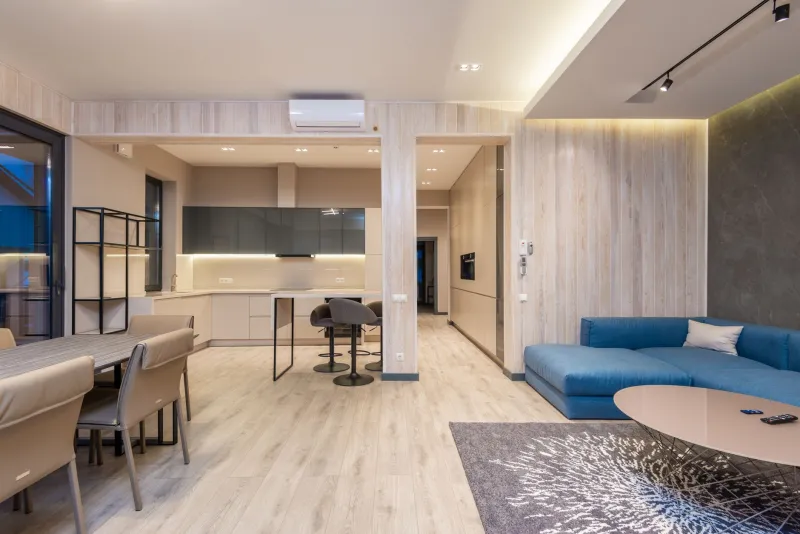
When your sightlines are clear and travel as far as possible through the space, your brain interprets the apartment as larger than it is. When they're interrupted — by a tall bookcase in the middle of a room, a sofa back that cuts across your view, or a cluster of furniture that creates a visual wall — the space suddenly feels boxed in.
To improve your sightlines without buying anything new:
- Lower the profile of your furniture. If you have a tall sofa or bulky armchair, consider whether a lower-profile piece (or even just rotating what you have) could open up the visual horizon.
- Create clear diagonal views. The longest sightline in any room is typically corner to corner. Keep that diagonal as unobstructed as possible.
- Use open-leg furniture. Pieces with visible legs allow light and sightlines to travel underneath them, making the floor plane feel continuous and larger.
How to Diagnose Your Own Apartment's Circulation Problem
You don't need a design degree for this — just a few minutes and a little honest observation.
Step 1: Do the walk-through test. Starting at your front door, walk naturally to every destination you hit daily — the couch, the kitchen, the bathroom, the bed. Don't plan your route; just move naturally. Notice every time you have to adjust your path, turn sideways, or navigate around something. Those friction points are your problem areas.
Step 2: Sit in your most-used spots and look up. Sit on your couch, your desk chair, your bed. From each spot, how far can your eyes travel before they hit something solid? If you feel visually hemmed in from your main seating areas, that's a sightline issue.
Step 3: Check the 36-inch rule. Grab a tape measure and check the clearance on your main paths. Anything under 30 inches is genuinely tight. Between 30–36 is workable but not comfortable. Over 36 is where things start to feel easy.
Step 4: Look at your room from the doorway. Stand at the entrance to each room and take a photo with your phone. The camera is weirdly good at revealing layout issues your eye glosses over in person. Does the furniture arrangement look balanced and open, or does it feel like everything is piled toward one side or blocking the natural entry?
Small Moves That Make a Real Difference
Once you've identified the problem spots, the fixes are often surprisingly simple:
- Float your furniture away from walls. It sounds counterintuitive, but pulling sofas and chairs a few inches away from the walls actually makes rooms feel bigger. It creates visual breathing room and improves the flow around the perimeter of the space.
- Ditch the furniture you don't need. In small apartments especially, one less piece of furniture can do more for a room's feel than any styling trick. If it's not earning its floor space, it might be the reason everything feels tight.
- Rethink your rug placement. A rug that's too small or awkwardly placed can visually chop up a room and create the illusion of less space. A properly sized rug — one that grounds the entire seating arrangement — unifies the space and makes it feel more intentional and open.
- Redirect furniture away from doorways and windows. Both of these architectural features need visual clearance to do their jobs. Blocking a window with a large piece of furniture doesn't just limit light — it interrupts the sightline to the outside, which is one of the most powerful tricks your apartment has for feeling larger.
The Bottom Line
A cramped-feeling apartment is rarely about a lack of square footage. It's almost always about how that square footage is being used — and more specifically, how freely people and sightlines can move through it. The invisible infrastructure of your layout is quietly running the show, whether you're aware of it or not.
The great news for renters: none of these fixes require permission, tools, or a big spend. They just require paying attention to the things most people walk past every single day without noticing. Once you start seeing the flow problems, you genuinely can't unsee them — and fixing them is one of the most satisfying apartment upgrades you'll ever make.