Why Your Bedroom Is Working Against You at Night (And How to Fix It Without Moving a Wall)
You've tried the melatonin. You've downloaded the white noise app. You've even splurged on a fancy pillow that promised to change your life. But if you're still waking up groggy or struggling to fall asleep, there's a good chance the problem isn't you — it's your floor plan.
Your bedroom isn't just a place to put a bed. It's a carefully (or not-so-carefully) arranged environment that sends constant signals to your nervous system. And depending on how your apartment was designed, those signals might be telling your brain it's time to stay alert long after you've called it a night.
Let's break down what's actually going on — and what you can do about it without a contractor or a landlord's permission.
The Window Situation Is Probably the Biggest Offender
Light is the single most powerful regulator of your circadian rhythm — the internal clock that tells your body when to sleep and when to wake up. Most apartment bedrooms in the US weren't designed with sleep science in mind. They were designed to look good on a listing.
That means your windows might be facing east, flooding your room with early morning sun before your alarm goes off. Or they face a streetlight-heavy urban corridor that keeps a low, persistent glow pulsing through your curtains all night. Either way, your brain is registering light when it should be registering darkness, and that disrupts the melatonin production your body depends on to fall — and stay — asleep.
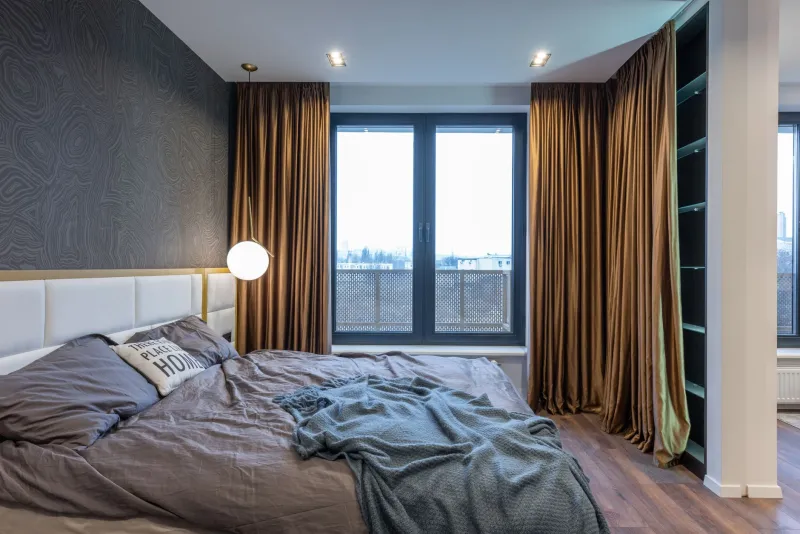
The fix: Blackout curtains are non-negotiable if you have a light-exposure problem, and the good news is they've gotten a lot more stylish in recent years. Look for lined velvet panels or linen-blend blackout options that hang from ceiling-height rods to maximize coverage. The key detail most people miss? Make sure the curtain rod extends several inches past the window frame on each side. Light leaks in from the edges more than through the fabric itself.
If your window faces east and you're a late sleeper or shift worker, consider layering a blackout roller shade behind your curtains for a double-block effect. It sounds like overkill until you sleep through your first full sunrise.
Where Your Bed Lives in the Room Matters More Than You Think
Feng shui gets a lot of eye-rolls in Western design circles, but the underlying logic — that spatial positioning affects how relaxed or alert you feel — is actually backed by environmental psychology. The "command position" concept, which suggests placing your bed so you can see the door without being directly in line with it, isn't mystical. It's about reducing the low-level anxiety your brain experiences when it can't monitor its environment.
If your bed is currently shoved against a wall with your back to the door, or positioned so your feet point directly at the entryway, your nervous system may be running a quiet background program of mild vigilance all night. It's subtle, but over time it chips away at sleep quality.
The fix: Reposition your bed so the headboard is against a solid wall and you have a clear sightline to the bedroom door. If your room is too small to make that work, even angling your furniture slightly or adding a low dresser near the door can give your brain the visual "coverage" it needs to settle down.
Your Bedroom Might Be Pulling Double Duty — And That's a Problem
This one hits hard for anyone living in a studio or a one-bedroom apartment in a city like New York, Chicago, or Los Angeles. When your bedroom is also your home office, your streaming room, and your late-night snack zone, your brain stops associating it exclusively with rest. Sleep researchers call this "stimulus control" — basically, your brain learns to link your bed with wakefulness instead of sleep, and that association is hard to shake.
The layout of your apartment might be forcing this on you. If there's literally nowhere else to put your desk or your TV, you're not failing at sleep hygiene — you're dealing with a real spatial constraint.
The fix: You can't always change the square footage, but you can change the visual cues. Use a bookshelf, a curtain panel hung from the ceiling, or even a large indoor plant to create a soft visual boundary between your work zone and your sleep zone. When you're done for the day, close a curtain, turn the monitor away, or drape a throw over your desk setup. The goal is to give your brain a clear visual signal that the "work" part of the room has been switched off.
Temperature Zones and Airflow Are Layout Issues Too
Here's one most people don't consider: the way your apartment is built determines how air moves through your bedroom, and that directly affects your sleep temperature. Bedrooms at the end of a long hallway, rooms above garages, or spaces with only one small window tend to trap heat or stay stuffy in a way that central air can't fully fix.
Sleep science is pretty consistent on this — the ideal sleep temperature for most adults is somewhere between 65 and 68 degrees Fahrenheit. Even a few degrees above that can fragment your sleep cycles without you realizing why you're waking up.
The fix: A small tower fan positioned to create cross-ventilation (even if you're just moving air from one side of the room to the other) can make a real difference. If your bedroom runs hot, pull your bed slightly away from exterior walls in summer — walls absorb heat during the day and radiate it back at night. Swapping to breathable cotton or Tencel bedding is a low-cost upgrade that pays off surprisingly fast.
The "Relaxation Gradient" Your Room Might Be Missing
One of the quieter layout problems is a lack of visual transition between the active parts of your home and your sleep space. If you walk directly from a bright, busy living room into your bedroom with no decompression zone, your nervous system doesn't have time to shift gears.
This is especially common in open-concept apartments or smaller units where the bedroom is just a few steps from the kitchen or front door.
The fix: Create a mini ritual that uses your physical space as a cue. Dim your bedroom lights 30 to 45 minutes before bed using a lamp on a smart plug or a simple dimmer switch (many rental-friendly options don't require hardwiring). Keep one low-wattage lamp on your nightstand and nothing brighter in the room after a certain hour. Over time, the act of lowering the light becomes the signal your body needs to start winding down.
Scent works the same way. A small diffuser with lavender or cedarwood near your bed engages a completely different sensory channel and reinforces the "this is the sleep zone" message your layout might otherwise be muddying.
Your Space Can Work With You, Not Against You
The thing about sleep problems rooted in your apartment's layout is that they're fixable — even as a renter, even without spending a fortune, and definitely without breaking your lease. It just requires looking at your bedroom the way a sleep researcher might: as an environment full of inputs your brain is constantly processing, for better or worse.
Small repositions, smarter window treatments, and intentional sensory cues won't rebuild your floor plan. But they can absolutely rebuild the quality of the sleep you're getting inside it.