Your Brain on Home: The Science of Designing an Apartment That Actually Makes You Happy
You've probably walked into someone's apartment and felt an immediate, inexplicable lift — like the room itself was rooting for you. And then there's the other kind of place: technically fine, nothing wrong with it, but somehow it just... deflates you. Same square footage, wildly different feelings. What's actually going on?
Spoiler: it's not magic. It's neuroscience. And the good news is that once you understand what your brain is responding to, you can make targeted, affordable changes that turn your space into a genuine mood-booster — no gut renovation required.
The Dopamine-Design Connection (Yes, It's Real)
Dopamine is the brain's feel-good messenger. It fires when you experience novelty, reward, beauty, and anticipation. Most people associate it with scrolling social media or eating a great taco, but researchers in environmental psychology have spent decades studying how physical spaces trigger — or suppress — the same neurological pathways.
A 2015 study published in the journal Trends in Cognitive Sciences found that visual complexity and novelty in environments consistently activated reward circuits in the brain. Translation: a thoughtfully layered, visually interesting room can literally give your brain a small hit of happiness just from existing in it. The flip side is equally true — sparse, monotonous, or cluttered spaces can suppress those same circuits, leaving you feeling flat without knowing why.
So what specific design moves actually move the needle?
Let There Be (Natural) Light
If there's one thing the research agrees on, it's this: natural light is a non-negotiable mood ingredient. Exposure to daylight regulates your circadian rhythm, boosts serotonin production, and — critically — sets the stage for healthy dopamine cycles throughout the day.
For renters, maximizing whatever natural light you have is one of the highest-return design moves you can make. Swap out heavy blackout curtains for sheer linen panels that filter light without blocking it. Pull furniture away from windows so the light can travel deeper into the room. Add mirrors on walls perpendicular to windows to bounce daylight into darker corners.
If your apartment is genuinely light-starved — basement unit, north-facing windows, tree-blocked — consider full-spectrum light bulbs, which mimic the wavelength composition of natural sunlight far better than standard LEDs. They're inexpensive, easy to find at any hardware store, and neurologically, they're doing a lot of heavy lifting.
Color Is Chemistry
Color psychology gets oversimplified constantly ("blue is calming, red is energizing, done"), but the actual science is more nuanced and more useful. What matters isn't just hue — it's saturation, brightness, and context.
Research from the University of British Columbia found that saturated blues tend to enhance creative thinking and open awareness, while warmer tones in the red-orange family can increase energy and alertness. But here's the part most design articles skip: highly saturated versions of any color, used in large doses, can actually increase cortisol (your stress hormone) over time.
The sweet spot for a dopamine-friendly apartment? Mid-tone, slightly muted versions of warm and earthy colors — terracotta, warm sage, dusty ochre, soft caramel. These tones are associated with natural environments, which your brain is evolutionarily primed to find calming and rewarding. As a renter, you can get there without painting a single wall. Throw pillows, area rugs, artwork, and curtains in these tones can shift the entire emotional register of a room.
Texture: The Underrated Mood Molecule
Here's something most people don't know: your brain processes tactile information even when you're not touching anything. Just seeing a chunky knit blanket, a smooth ceramic vase, or a rough-hewn wooden shelf activates sensory cortex regions associated with touch — a phenomenon called "haptic simulation."
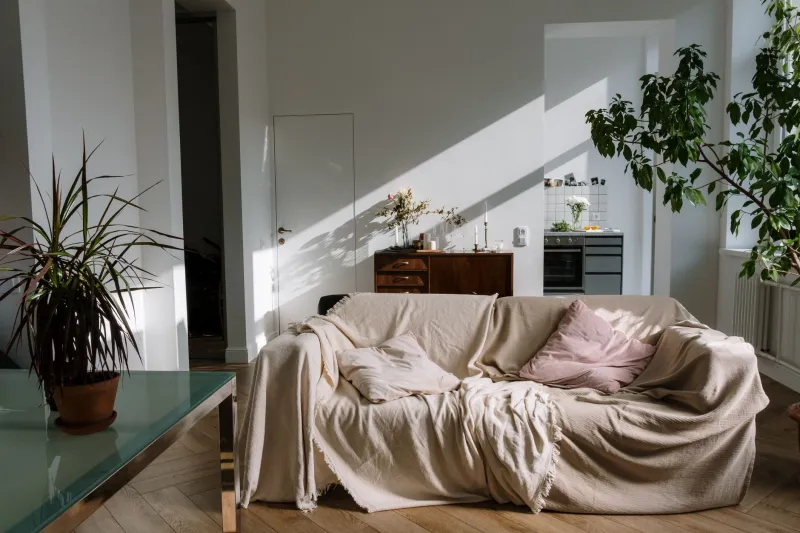
Why does this matter for your apartment? Because visually rich textures create a sense of warmth, depth, and comfort that smooth, flat surfaces simply can't replicate. A room full of IKEA basics in the same finish can look fine in photos but feel oddly sterile in person. Layer in a jute rug, a linen sofa throw, some matte ceramic vessels, and a wood-toned side table, and suddenly the room feels like it has a heartbeat.
This is completely renter-friendly — none of it requires permanent changes, and you can build a texturally layered space on a real budget. Thrift stores and places like HomeGoods or TJ Maxx are goldmines for exactly this kind of tactile variety.
Bring the Outside In (Literally)
Decades of research on biophilic design — the idea that humans have an innate need to connect with natural elements — consistently show that incorporating plants, natural materials, and organic shapes into interior spaces reduces stress hormones and increases feelings of well-being.
A 2019 meta-analysis in the journal Building and Environment found that indoor plants alone measurably reduced psychological stress in study participants. And you don't need a jungle. Even a single pothos on a shelf or a fiddle-leaf fig in a corner registers with your nervous system as a signal of a living, safe environment.
Beyond plants, think natural materials: wood, stone, linen, rattan, clay. These aren't just aesthetic trends — they're environmentally coded signals that your brain interprets as grounding and secure. A ceramic lamp base, a woven basket, a wooden cutting board displayed on the counter — small, affordable, and neurologically meaningful.
Spatial Arrangement and the Sense of Control
One of the less-discussed dopamine triggers in interior design is the feeling of agency — the sense that your environment is organized, navigable, and under your control. Research in environmental psychology links spatial clarity directly to reduced anxiety and improved cognitive performance.
This doesn't mean your apartment needs to look like a minimalist showroom. It means that intentional arrangement — furniture that creates clear pathways, a defined purpose for each zone, visible order even within a maximalist aesthetic — signals to your brain that you're in a safe, manageable space.
A practical move: identify one area of your apartment that currently feels chaotic or undefined, and give it a job. A corner that's become a dumping ground can become a reading nook with a secondhand chair and a floor lamp. A kitchen counter perpetually buried in mail can be cleared and anchored with a small tray that corrals just the essentials. These micro-interventions are disproportionately powerful because they create what psychologists call "environmental mastery" — and your brain rewards that feeling generously.
You Don't Need a New Apartment. You Need a Smarter One.
The science here is genuinely encouraging because it points away from expensive overhauls and toward thoughtful, accessible choices. Natural light, layered texture, biophilic elements, intentional color, and clear spatial logic — none of these require a big budget or a landlord's permission. They require attention.
Your apartment is already in conversation with your brain, whether you've designed it or not. The only question is whether that conversation is working for you or against you. With a few deliberate moves, you can make it work a whole lot harder — and start feeling the difference before the week is out.